Moving day in the Brazos Valley rarely goes the way the calendar promises. A forecast that looked clear on Monday can turn into a line of spring thunderstorms by Friday, or a Gulf system can park over the county and drop two inches of rain between the first load and the last. Bryan averages roughly 39 to 41 inches of rain a year, and most of it falls in two clusters: May and June, then September and October. Those months overlap with lease turnover, Texas A&M fall move-in, and the second student wave from Blinn College's Bryan campus, so the year's busiest moving window is also its wettest and hottest.
That combination is why choosing a moving and storage service with a real bad-weather protocol matters more here than it might somewhere drier. Wet cardboard collapses. Particleboard desks swell and never recover. A muddy hallway can cost a renter a deposit. A rain-slick truck ramp is the fastest way to turn a routine carry into an injury. None of that is unavoidable, but none of it fixes itself either.
This article walks through five tips for moving in bad weather around Bryan, Texas: how to schedule around the region's storm patterns, which packing materials hold up in humidity, how movers protect floors and footing, when short-term storage is the smartest move you can make, and what your paperwork says about who pays if something gets soaked.
Tip One: Schedule Around Bryan's Weather Patterns, Not Against Them
The single cheapest form of weather protection is picking a better date. A moving and storage service can work in rain, but the day will run slower, and the risk of damage rises, so building slack into the calendar pays for itself.
What the Local Calendar Looks Like
Spring, from March through May, brings hail and severe thunderstorm warnings. Late August and September bring Gulf moisture and the peak of remnant tropical systems; Harvey in 2017 and Imelda in 2019 produced the region's worst moving-day flooding. Atlantic hurricane season runs from early June into late November. Winter ice is rare but real.
Then there is traffic. Kyle Field home Saturdays draw crowds above 100,000 and shut down routes across both cities, so gameday scheduling is a self-inflicted wound. Lease turnover clusters at the end of July and the start of August, when highs run 95 to 100 degrees, and the heat index climbs past 105, pushing crew start times to 6 or 7 a.m.
Build In a Backup Window
Ask about these specifics when you book:
- A rain-delay policy - what happens if a storm arrives mid-load, and whether the crew can finish the next morning.
- A named alternate date, held loosely, in the same week.
- Start-time flexibility so an early launch can beat an afternoon storm cell.
- Route awareness of ponding at the Carter Creek and Burton Creek crossings, and on parts of Villa Maria Road, Texas Avenue, Briarcrest Drive, and the Highway 6 frontage roads.
Movers that already reroute between Bryan, College Station, Navasota, and Caldwell, Texas, on normal days will have alternates ready when a low-water crossing goes under.
Tip Two: Upgrade Your Packing Materials Before the Weather Turns
Most weather damage is a packing failure, not a driving failure. Cardboard loses roughly half its stacking strength in high humidity, so a box that held a full kitchen on a dry day can buckle in a damp truck.
Swap Cardboard for Plastic Where It Counts
Plastic totes, mattress bags, and dish-pack cartons are the wet-weather upgrades worth paying for. Put books, paper files, linens, and anything with sentimental value in totes. Dishes belong in dish packs with cell dividers, not in a reused liquor-store box. A full-service moving and storage service will usually supply these and pack them on-site, which also keeps the load list accurate.
Wrap in the Right Order
Order matters more than material. Shrink wrap applied directly over damp upholstery traps moisture against the fabric, and mildew can appear within 24 to 72 hours. The correct sequence is breathable furniture blankets first, then stretch wrap only as an outer shell, and only for the trip.
Three categories deserve extra attention:
- Particleboard and MDF furniture, including most dorm desks and flat-pack dressers, swells permanently once wet. Unlike solid wood, it cannot be dried out.
- Mattresses absorb water fast and dry slowly. A sealed mattress bag costs a few dollars and solves it.
- Electronics carried from a cool truck into a warm apartment condense internally. Standard practice is to let them acclimate 12 to 24 hours before powering anything on.
Homeowners from Brenham to Hearne, Texas, face the same humidity, so these rules apply across the service area.
Tip Three: Protect Floors, Thresholds, and Footing
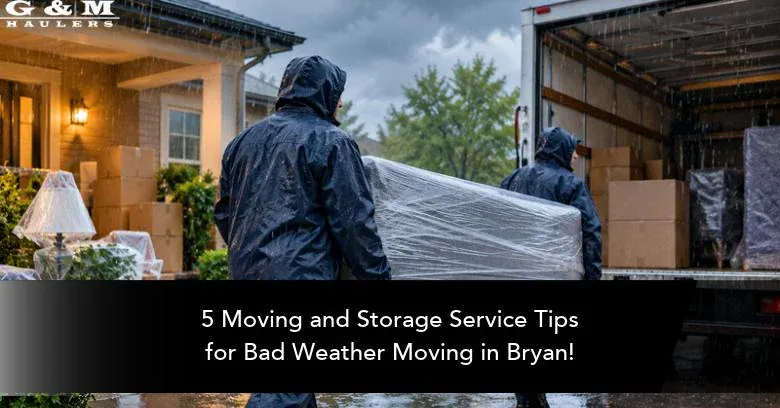
Rain turns a move into a mud problem, and landlords notice mud. A professional moving and storage service treats floor protection as a setup task, not an afterthought, and the sequence is consistent:
- Neoprene or canvas runners down the center of carpeted rooms and hallways.
- Masonite or Ram Board over hardwood and tile, where water and grit do the most scratching.
- Flat cardboard at thresholds and doorway transitions, which take the heaviest foot traffic.
- A towel-and-tarp station just inside the door so every crew member wipes down on the way in.
- A tarp over the truck's open deck between carries so the load doesn't collect standing water.
Footing deserves the same discipline. Truck ramps get slick quickly, so crews switch to the lift gate, add grip tape or rubber tread, and shuttle smaller loads instead of overloading dollies. Shoulder dollies help on stairs when hand trucks become unsafe. Downtown Bryan's historic blocks complicate all of this with narrow streets, no loading dock, upper floors without elevators, and street-parking arrangements for a 26-foot truck. Experienced movers plan the staging area before the first box leaves the house, which is why that kind of moving and storage service tends to finish faster in bad conditions.
Operations typically halt for lightning, but not for rain. Teams will pause and wait for 30 minutes following the last sound of thunder before continuing their work.
Tip Four: Treat Short-Term Storage as a Weather Release Valve
When a storm sits over the county on closing day, the best answer is often to move the load out of the house, hold it safely, and deliver when conditions improve. A combined moving and storage service can load today, store for a few days, and deliver without a second full pack-out.
Climate-Controlled or Standard
Climate-controlled units typically maintain temperatures between 55 and 80 degrees and humidity under about 55 percent. Nationally, a 10x10 climate unit runs roughly $110 to $200 a month, against about $70 to $130 for a non-climate unit. For a few days of rain delay in mild weather, standard storage is usually fine. Climate control pays for itself with mattresses, leather sofas, antiques, solid-wood furniture, musical instruments, electronics, and anything with paper or photographs.
Common Short-Term Storage Scenarios
Storage solves problems that have nothing to do with rain, too:
- A lease gap between the end of July and a mid-August move-in date.
- A closing that slips by a week.
- A student heading home for the summer who needs a dorm's worth of belongings held.
- A downsizing move where the new place is not ready.
Families relocating between Bryan and Caldwell, Texas, often use a holding week to stage the move in two trips instead of one brutal day. Ask any moving and storage service how access works, whether items stay palletized and wrapped, and how quickly delivery can be scheduled once the forecast clears.
Tip Five: Understand the Paperwork Before Anything Gets Wet
Read about liability before the truck is loaded, not after a dresser comes off damp. Texas movers of household goods must be registered with the TxDMV, and they are required to provide a consumer rights booklet explaining your rights and responsibilities when you move in Texas. Read it. The part that surprises people is valuation: basic carrier liability is typically 60 cents per pound per article unless you purchase full-value protection. A soaked 40-pound dresser pays about $24.
Hourly cost deserves the same clarity. Two movers and a truck commonly run about $120 to $200 an hour locally, and rain can add 15 to 30 percent to load time because of slower shuttling, wiping down, and extra floor protection. A moving and storage service that explains that up front is being honest, not padding the bill. Ask for a written estimate, ask what triggers additional time, and get the answers before moving day.
Apartment moves add one more layer. Many complexes require a certificate of insurance from the moving company and a reserved elevator window. Confirm both a week out, and ask your movers what happens if the job runs past the reservation. Renters in Caldwell, Texas, and smaller surrounding towns face fewer elevator rules, but gate codes and gravel driveways create their own wet-weather headaches. Good moving and storage services will scout both before the truck arrives.
The Bottom Line
Bad weather does not have to ruin a move. You just have to plan for it. Pick a date with slack in it. Pack the fragile and moisture-sensitive items in plastic, not cardboard. Expect movers to lay down floor protection, use a tarped deck, and know that they will pause for lightning. Keep short-term storage on the table as a release valve. Read the valuation terms before the first box goes on the truck.
Residents in the Bryan and Caldwell, Texas, areas know the forecast changes fast, so the right moving and storage service brings a rain plan, the right materials, and a clear estimate. Start now to book a free estimate, confirm your elevator window, and lock in a backup date before the next storm season fills the calendar!
Key Takeaways
- Book early and ask for a named backup date, because Bryan's rain peaks in May and June, then again in September and October.
- Use plastic totes, mattress bags, and dish packs for anything you cannot replace, since cardboard loses about half its stacking strength in high humidity.
- Never shrink-wrap damp upholstery directly. Instead use furniture blankets first, since trapped moisture can grow mildew within 24 to 72 hours.
- Let electronics acclimate 12 to 24 hours before powering them on after a move between temperature extremes.
- Confirm your valuation coverage in writing, because basic liability pays roughly 60 cents per pound per article.
Frequently Asked Questions
Do movers work in the rain, or will my date be canceled?
Crews generally work in the rain, but they stop for lightning. The standard is to pause and wait 30 minutes after the last audible thunder, then resume loading.
Does rain increase the hourly bill?
It can, because wet conditions typically add 15 to 30 percent to load time. The hourly rate stays the same, but the extra care takes longer.
Who pays if my furniture is damaged by water?
That depends on the valuation you selected. Basic carrier liability is typically 60 cents per pound per article, while full-value protection covers repair or replacement and costs more.
Can I store things for a few days until the weather clears?
Yes, and it is one of the better bad-weather options. Your belongings are loaded, wrapped, secured, and then delivered once conditions improve.
Is climate-controlled storage worth it for a mattress, leather sofa, or antiques?
Yes, for those items specifically. Climate units typically hold 55 to 80 degrees with humidity under about 55 percent, which protects leather, solid wood, and anything with paper or fabric.
How do you keep mud off my carpet and apartment hallway?
Runners go down on carpet, Masonite or Ram Board on hardwood and tile, and cardboard at thresholds. A towel station at the door lets the crew wipe down on every trip inside.
Should I avoid moving on a Texas A&M home game Saturday?
Yes, if you have any choice. Home games draw crowds of more than 100,000, close routes, and make it hard to position a 26-foot truck.